Strengthening Social Accountability and Inclusion in Timor-Leste’s Community Health System

A community-led accountability initiative that helped health teams in Timor-Leste strengthen feedback loops, coordinate local responses, and make service delivery more inclusive.

Timor-Leste

Health
2024-10-18 at 15.57.49 (1) 2024-10-18 at 15.57.4 (1)
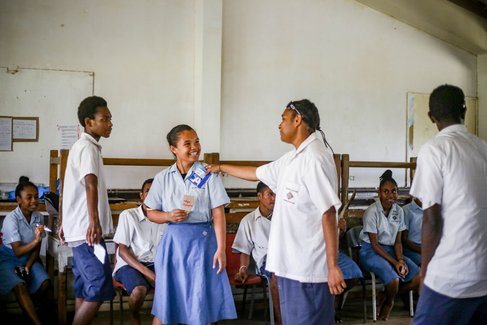
Launch and orientation activity in Ermera, bringing together participants from Suco Eraulo and Suco Riheu to collaborate and connect.

The Challenge

When community feedback is not visible or traceable, health systems have fewer ways to identify problems, include excluded groups, and respond before service gaps widen

Timor-Leste’s Ministry of Health has a mandate to deliver equitable, community-responsive health services across geographically dispersed and low-connectivity settings. But in practice, frontline teams and government partners often work with limited feedback from the communities they serve.

When reporting systems are fragmented, community feedback is difficult to trace, and local issues are not visible across the system, service delivery becomes harder to coordinate. Problems can take longer to identify, harder-to-reach groups can be left out of decisions, and local health teams have fewer opportunities to respond quickly with the information they need.

This is especially important for people who are often excluded from formal decision-making, including women, young people, and people with disabilities. Without structured ways for these groups to raise priorities and participate in local health discussions, accountability mechanisms risk reinforcing the same gaps they are meant to solve.

The challenge was not simply to collect more information. It was to strengthen the processes, relationships, and tools that help communities and government work together — so that feedback becomes visible, traceable, and useful for action.

Community-based accountability depends on practical systems that people can use in real service delivery settings.
SAI issue tracker Training in Suco Eraulo SAI discovery session
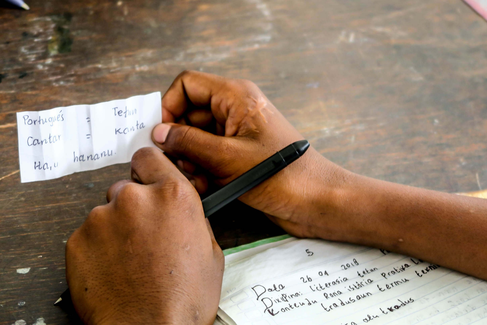
Photos from the discovery design workshop with health workers

Our Approach

Supporting communities and government to identify, track, and respond to local health issues together

Catalpa worked with the Ministry of Health Timor-Leste, the Global Partnership for Social Accountability through the World Bank, local civil society organisations, municipal and national health officials, community leaders, and Village Health Assemblies to strengthen social accountability in community health systems.

Rather than creating a parallel process, the work was designed to align with the Ministry of Health’s existing Community-Based Monitoring framework. Government partners retained ownership of priorities and implementation, while Catalpa supported the design and delivery of practical workflows, governance arrangements, and digital tools that could help communities and officials identify, track, and respond to service delivery issues.

At the centre of the work was the Suku Social Accountability and Inclusion Toolkit: a co-designed toolkit developed to reflect local operating realities and support structured engagement between communities and government. The toolkit helped Village Health Assemblies and health officials use shared processes to identify issues, review evidence, coordinate responses, and monitor progress.

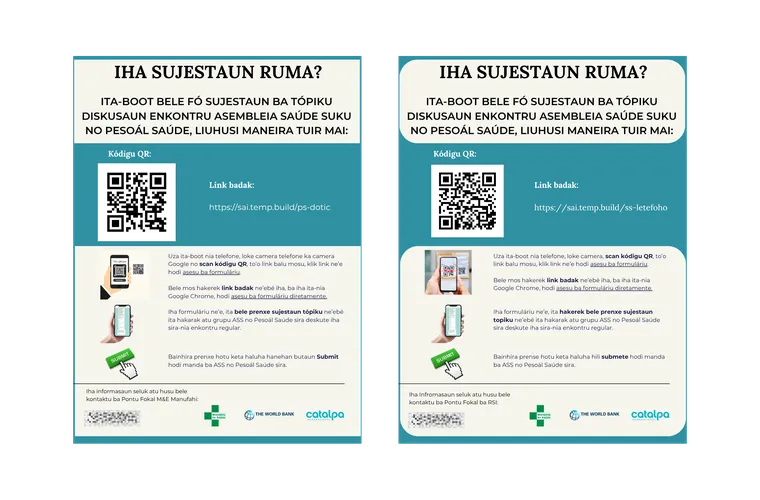
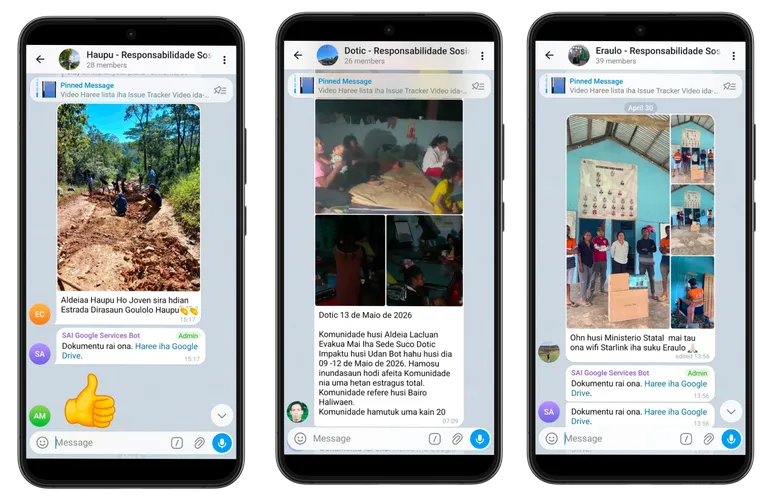
The approach combined community engagement, capability strengthening, and simple digital infrastructure. Local civil society organisations provided ongoing mentoring, while 245 Village Health Assembly members were trained in accountability and inclusion. Low-cost tools — including issue trackers, calendars, and feedback systems — supported more consistent reporting, clearer traceability, and better coordination across community and government actors.

These tools were designed for low-connectivity environments and offline-first workflows, recognising the realities of service delivery in remote settings. The pilot was implemented across four Suku in Ermera and Manufahi municipalities.
quote-top

Accountability works when communities and government have shared ways to identify problems, track progress, and act together.

Catalpa project team

quote-bottom

IMPACT

Stronger feedback loops, more inclusive decisions, more responsive services

245 Village Health Assembly members trained
4 Suku reached across Ermera and Manufahi
1,300+ Messages, photos, and files shared through the system
27 Health-related issues identified
15 Issues resolved during the pilot period

The Impact

The pilot made community feedback easier to track, improved coordination between communities and government, and helped local health data inform planning and service delivery.

Community data became easier to see, use, and act on

The pilot strengthened local accountability processes and improved coordination between communities and government. Communities and health officials increasingly worked together to identify, prioritise, and address local health issues, supported by more structured information flows and shared visibility of progress.

The work showed that social accountability is not only about raising concerns. It is about creating the conditions for those concerns to move through a system — from community discussion, to evidence review, to government planning, to follow-up action.

Improved coordination and communication

More than 1,300 messages, photos, and files were shared through the system, giving stakeholders a clearer and more transparent way to coordinate around local health issues. This reduced information gaps and helped communities, civil society organisations, and government actors respond more quickly together.

Local issues were identified and resolved

Across the pilot sites, communities identified 27 health-related issues, with 15 resolved during the pilot period. This strengthened local problem-solving capacity and reduced delays in addressing service gaps.

More inclusive participation in decision-making

Women, young people, and people with disabilities were consistently involved in discussions. Some communities also included LGBTQI+ participants. Broader participation helped improve the relevance and equity of decisions, ensuring local health priorities reflected a wider range of community experiences.

Digital tools worked in low-resource settings

Communities were able to use digital tools despite constraints such as limited connectivity and device access. This demonstrated the feasibility of digitally enabled accountability systems in remote and low-resource contexts, especially when tools are simple, low-cost, and designed around offline-first workflows.

Government used community-generated data

Municipal and national health officials used community-generated data in planning and monitoring processes. This helped strengthen evidence-informed decision-making and improve alignment between community needs and government action.

Built for sustainability

Stewardship, ownership, and capability inside existing systems

Sustainability was approached through stewardship: strengthening ownership, capability, governance, and resourcing within existing systems rather than relying on external structures.

The work aligned with Ministry of Health Community-Based Monitoring guidelines, supporting institutional integration rather than a parallel accountability system. Training and mentoring helped build local capacity to continue facilitation, monitoring, and coordination. The toolkit reinforced practical workflows that can be sustained within existing community and government structures.

Digital tools played an enabling role, not a standalone one. They were designed to be low-cost, adaptable, and usable in low-connectivity environments, reducing dependency on external support while strengthening the behaviours that make accountability systems work: consistent reporting, shared visibility, coordination, and follow-up.

quote-top Beneficiary - Esmenia Afonso Pereira
quote-top

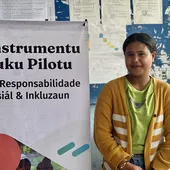
As a young girl and member of GSI who joined the ASS structure, I feel very happy that this program exists. The Telegram app helps us share information and respond to issues quickly. The simple suggestion form also makes it easy for the community to share their ideas confidentially.

Beneficiary - Esmenia Afonso Pereira

quote-bottom
World-Bank-Logo.png Logo Saude GPSA logo

Sign up for our newsletter

Learn about how we're doing good, better.